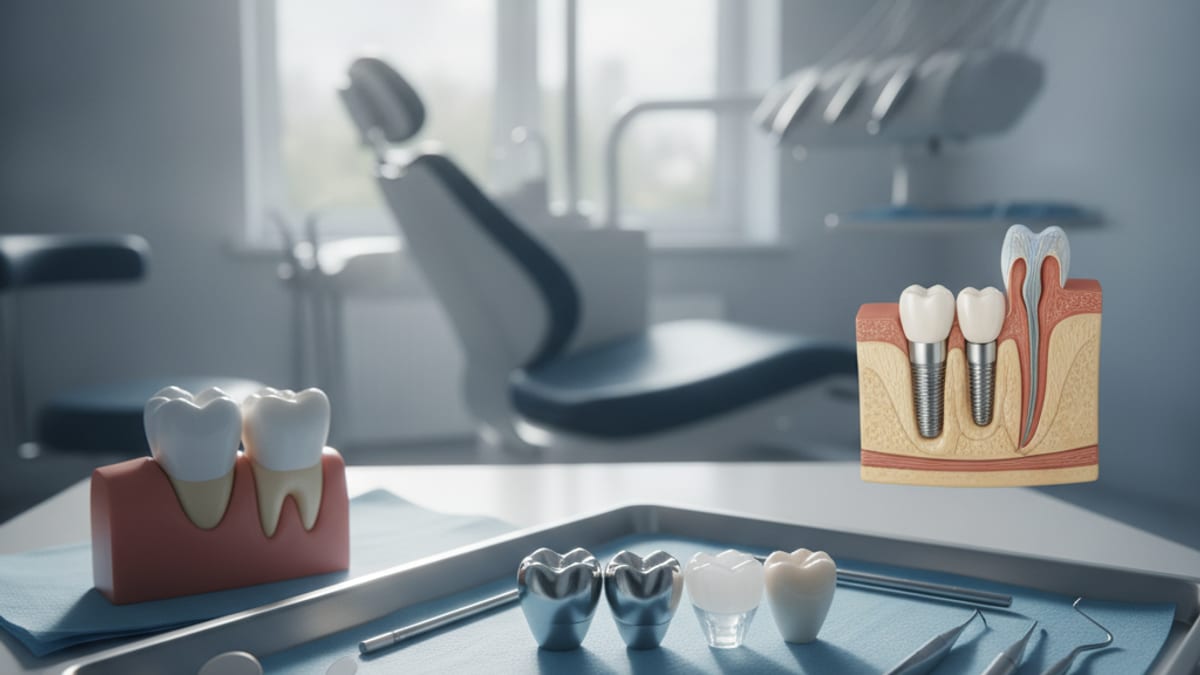
Biomechanical Essentials & Material Science
A dental crown is a custom-engineered full-coverage prosthetic restoration designed to rebuild a structurally compromised tooth, protect endodontically treated teeth from catastrophic fracture, or anchor fixed dental bridges. Achieving clinical longevity requires rigorous adherence to biological width principles, precise finish-line margin preparation, and optimal material selection balancing masticatory load with aesthetic demands.
1. Indications and Biomechanical Objectives of Crown Therapy
Dental crowns serve as the final restorative shield when a tooth lacks sufficient healthy dentin to support direct composite restorations or indirect inlays/onlays. Key clinical indications include:
- Post-Endodontic Restoration: Teeth following root canal therapy lose internal moisture and dentinal elasticity. Placing a full-coverage crown provides a 360-degree 'ferrule effect' of at least 2.0 mm of sound tooth structure, dramatically reducing vertical root fracture risks under chewing forces.
- Severe Structural Breakdown: Extensive carious lesions, cracked tooth syndrome, or large failing amalgam restorations undermining cuspal stability.
- Full-Arch Rehabilitation & Occlusal Vertical Dimension (OVD): Re-establishing lost vertical height caused by severe chemical acid erosion, gastric reflux, or severe grinding attrition.
2. Material Science: Zirconia, E.max, Porcelain-Fused-to-Metal (PFM), and Gold
Contemporary prosthodontics has largely phased out legacy metal-based alloys in favor of biocompatible all-ceramic materials:
- Monolithic Zirconia (3Y-TZP to 5Y-PSZ): High-strength ceramic engineered from zirconium dioxide stabilized with yttria. It boasts unmatched fracture toughness (up to 1,200 MPa), making it the premier choice for posterior molars and multi-unit long-span bridges where biting forces exceed 500 Newtons.
- Lithium Disilicate (IPS e.max): Delivers optimal biomimetic translucency and light transmission for premolars and anterior teeth. Its flexural strength (500 MPa) exceeds masticatory forces in the anterior zone while offering unmatched aesthetic integration.
- Porcelain-Fused-to-Metal (PFM): Traditional crowns featuring a ceramic veneer fired over a cobalt-chromium metal coping. While mechanically proven over decades, PFM carries aesthetic liabilities, including gray cervical gingival shadowing over time as gums naturally recede.
| Crown Material | Flexural Strength | Occlusal Reduction | Biocompatibility | Recommended Zone |
|---|---|---|---|---|
| Monolithic Zirconia (3Y/4Y) | 900 - 1,200 MPa | 1.0 - 1.5 mm | Excellent (Inert) | Posterior Molars / Bridges |
| Layered Zirconia (Zi-Crest) | 600 - 900 MPa | 1.2 - 1.8 mm | Excellent | Anterior & Premolars |
| Lithium Disilicate (E.max) | 470 - 530 MPa | 1.0 - 1.5 mm | Exceptional | Incisors, Canines, Premolars |
| PFM (Cobalt-Chrome) | 450 MPa (Porcelain) | 1.5 - 2.0 mm | Moderate | Budget Posterior Replacement |
3. Tooth Preparation, Margin Architecture & Digital Scanning Workflow
Precision margin preparation is the determining factor in avoiding future secondary decay or chronic gingival inflammation. In modern clinics, the preparation protocol follows strict biological principles:
- Finish Line Design: A continuous chamfer or rounded shoulder margin is prepared with diamond burs under copious water cooling. Margins are placed either supragingivally (above the gum) or equigingivally (flush with the gumline) whenever possible to prevent invasion into the biological width (junctional epithelium and connective tissue attachment).
- Gingival Retraction & Digital Impression: A dual-cord retraction technique (sizes 000 and 1) or laser troughing displaces the free gingival margin. High-resolution intraoral scanners (e.g., 3Shape TRIOS, Medit i700, or CEREC Primescan) capture 50-micron accuracy 3D optical meshes without messy alginate impressions.
- CAD/CAM 5-Axis Milling: The 3D model is imported into CAD software where anatomical occlusion, interproximal contact pressure, and internal cement space (typically set to 30 to 40 microns) are calibrated. The restoration is milled from medical-grade blocks and sintered in high-temperature furnaces.
4. Clinical Cementation Protocols & Adhesive Longevity
The interface between the crown and natural tooth determines seal integrity. For zirconia, sandblasting the intaglio surface with 50-micron aluminum oxide at 2.0 bar followed by MDP-containing primers (such as Monobond Plus) and self-adhesive resin cement (e.g., RelyX Unicem) provides robust chemical-mechanical bonding. For E.max crowns, hydrofluoric acid etching (4.5% HF for 20 seconds) followed by silane coupling agents achieves true micromechanical integration with the tooth enamel and dentin.
5. Cost Comparison & International Patient Guidelines (2026)
In the UK NHS Band 3 or private clinics, a single quality zirconia crown costs £650 to £1,200. In Germany, Netherlands, and Scandinavia, prices range between €750 and €1,400 per tooth. In top-tier certified Turkish clinics equipped with in-house CAD/CAM laboratories, identical Grade-A German or Swiss monolithic zirconia crowns cost between £160 and £260 (€190 to €310), including digital 3D scanning, temporary crowns, and certified manufacturer traceability passports.
Clinical Frequently Asked Questions (FAQ)
Does getting a dental crown require a root canal treatment?
Not necessarily. If the tooth has vital, healthy pulp without irreversible pulpitis or periapical infection, a crown can be placed on a living vital tooth. Proper water-cooling and gentle conservative tooth preparation preserve pulp vitality in over 90% of cases.
How long does a modern zirconia crown last?
With proper oral hygiene, daily flossing, and regular dental check-ups, high-quality zirconia crowns frequently last 15 to 25 years. Because zirconia does not corrode or decay, the primary long-term risk is secondary caries on the natural tooth root underneath if hygiene is neglected.
Can dental crowns cause gray discoloration along the gums?
Only traditional PFM crowns cause gray lines due to their internal dark metal copings showing through as gums age. Modern all-ceramic Zirconia and E.max crowns are completely metal-free; their margins are white and translucent, ensuring natural, pink, healthy-looking gums forever.