
Full-Arch Biomechanics & Immediate Loading Protocols
Full-arch implant rehabilitation restores edentulous or terminally dentate jaws using fixed prosthetic bridges anchored by strategically angled implants. Deciding between the All-on-4 and All-on-6 protocols is dictated by bone density, arch width, opposing dentition force, and the anteroposterior (A-P) spread. Understanding these biomechanical parameters guarantees lifelong masticatory stability without prosthetic framework fractures.
1. Biomechanics of Tilted Implants & Anteroposterior (A-P) Spread
Developed clinically by Dr. Paulo Malo, the All-on-4 concept revolutionized implantology by tilting the two posterior implants up to 30 to 45 degrees. This strategic angulation avoids entering the maxillary sinus cavities in the upper jaw and avoids the inferior alveolar nerve canal in the lower jaw. Tilting significantly increases the contact area between the implant and dense cortical bone while widening the Anteroposterior (A-P) spread, drastically reducing the length of cantilevered distal extensions.
2. Clinical Comparison: All-on-4 vs. All-on-6
The choice between four or six implants is governed by strict anatomical and biomechanical criteria:
- All-on-4 Protocol: Ideal for patients with moderate-to-severe alveolar bone resorption who wish to bypass complex sinus lift or extensive bone block grafting surgeries. Highly predictable in the dense cortical bone of the mandible (lower jaw).
- All-on-6 Protocol: Preferred in the maxilla (upper jaw), where trabecular bone is softer and less dense (D3/D4 bone). Placing six implants distributes occlusal biting forces across 50% more surface area, providing biomechanical redundancy. If one implant fails to integrate over decades, the remaining five fixtures can often continue supporting the full arch without requiring complete surgical reconstruction.
| Biomechanical Parameter | All-on-4 Protocol | All-on-6 Protocol |
|---|---|---|
| Primary Bone Indication | Moderate to severe atrophy | Adequate residual ridge volume |
| Need for Sinus Bone Grafting | Avoided via angled posterior implants | May require minor sinus lift / grafting |
| Ideal Jaw Application | Mandible (Dense D1/D2 bone) | Maxilla (Soft D3/D4 bone) |
| Prosthetic Cantilever Length | Slightly longer (requires rigid titanium bar) | Minimized (Better posterior load spread) |
| Biomechanical Redundancy | Low (All 4 essential) | High (Built-in biological safety margin) |
3. Immediate Loading Protocol: "Teeth in a Day" Workflow
Modern surgical clinics execute immediate loading under strict digital guidance:
- 3D CBCT Virtual Guided Surgery: Implants are planned in surgical CAD software. A 3D-printed surgical template guides drills with sub-millimeter precision.
- Torque Verification: Implants must achieve an insertion torque of at least 35 to 45 Ncm and an ISQ (Implant Stability Quotient) exceeding 70 to qualify for immediate loading.
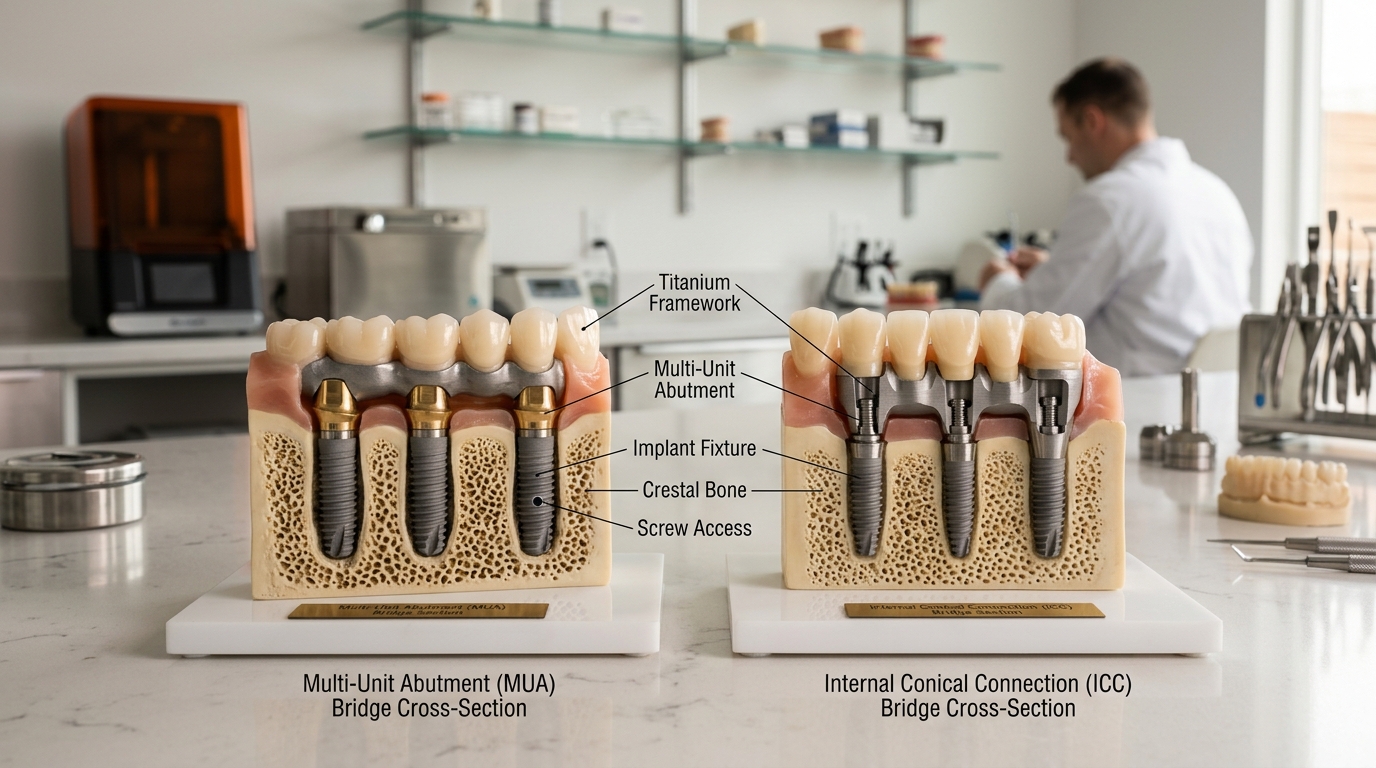
- Same-Day Provisional Bridge: Multi-unit abutments are secured, and a high-strength acrylic temporary bridge reinforced with a metal framework is screwed into place within 24 hours. The patient leaves with fixed, non-removable, functional teeth.
- Final Sintered Zirconia Bridge: After 3 to 6 months of complete osseointegration, the permanent monolithic multilayer zirconia bridge supported by a milled titanium bar is placed.
4. Cost Comparison: Europe, UK vs. Turkey (2026)
In the UK or private US centers, a single arch All-on-4 treatment costs between £12,000 and £18,000 ($16,000 to $25,000), while All-on-6 often exceeds £22,000. In top-tier Turkish surgical centers utilizing genuine Swiss Straumann or Swedish Nobel Biocare implants and in-house CAD/CAM labs, complete full-arch rehabilitation costs £2,800 to £4,500 (€3,200 to €5,200) for All-on-4 and £3,400 to £5,500 for All-on-6, including temporary teeth, 3D imaging, and luxury hotel accommodation.
Clinical Frequently Asked Questions (FAQ)
Can I eat normally with the immediate provisional teeth?
During the initial 3 months of osseointegration, you must adhere to a soft-food diet (pasta, fish, eggs, cooked vegetables). Hard foods like nuts or raw carrots can introduce micro-movements, disrupting bone healing.
Is the All-on-4 bridge removable by the patient?
No. The bridge is firmly screwed into multi-unit abutments by the dentist and functions like natural teeth. Only your dentist can unscrew the bridge during your annual maintenance visits.
Which material is best for the permanent bridge: Acrylic or Zirconia?
Monolithic multilayer zirconia supported by a CAD/CAM titanium framework is the gold standard in 2026. Unlike acrylic or resin hybrid teeth, zirconia will not stain, wear down, chip, or absorb food odors over decades.
Comprehensive Clinical Quality Assurance & Post-Operative Safety Protocols
Ensuring predictable, long-term biological stability for All-on-4 vs. All-on-6 Dental Implants: Clinical Indications, Bone Density & Cost Guide requires strict adherence to international evidence-based dental guidelines. Clinical success is not merely achieved during active treatment hours; it depends on the precise physiological management of surrounding hard and soft tissues during the critical post-operative healing window. When dental restorations or surgical implants are placed, the surrounding vascular architecture undergoes complex cellular remodeling, requiring patient-specific pharmacological support, occlusal load balancing, and anti-inflammatory hygiene protocols.
Every clinical case treated within accredited hospital-grade dental facilities in Turkey undergoes a multi-disciplinary quality review involving prosthodontists, periodontists, and oral surgeons. Prior to final discharge, high-resolution diagnostic intraoral scans and verification radiographs are captured to confirm marginal adaptation, absence of subgingival cement overhangs, and harmonic balance across dynamic excursive chewing movements. Patients receive an individualized clinical dossier containing high-resolution digital radiographs, complete manufacturer traceability lot numbers, and a 24/7 dedicated medical emergency line.
Contraindications, Clinical Risk Stratification & Biological Longevity
While modern digital dentistry delivers unprecedented clinical predictability, ethical clinicians must evaluate systemic and behavioral risk factors that could undermine biological longevity:
- Severe Nocturnal Bruxism & Parafunctional Clenching: Excessive unmanaged occlusal forces represent the leading mechanical cause of ceramic micro-fractures, screw loosening, and bone overload. Patients with verified bruxism must be fitted with custom-milled dual-laminate hard/soft occlusal night guards before departing for their home country.
- Compromised Periodontal Health: Active gingival inflammation or untreated periodontitis compromises the biological seal of crowns and implants. Complete scaling, root planing, and subgingival biofilm debridement must precede any definitive prosthodontic or surgical procedures.
- Systemic Microvascular Disorders: Heavy tobacco consumption and uncontrolled diabetes mellitus impair microvascular angiogenesis, delaying soft-tissue wound closure and increasing complication rates. Clinicians require strict smoking cessation during the perioperative phase.
By pairing world-class European biomaterials with rigorous biological safeguards, patients achieve functional comfort, pristine aesthetics, and clinically documented survival rates spanning decades.