
Clinical Overview & Aesthetic Fundamentals
A Hollywood Smile makeover refers to a comprehensive aesthetic rehabilitation that restores the entire smile zone (typically 8 to 10 teeth per arch) using custom-fabricated dental veneers or crowns. Rather than a one-size-fits-all aesthetic, modern cosmetic dentistry employs 3D facial mapping and Golden Proportion ratios (1.618:1:0.618) to match tooth morphology with facial contours, lip line mobility, and skin complexion.
1. What Is a True Hollywood Smile Makeover?
In contemporary aesthetic dentistry, a Hollywood Smile is not merely a cosmetic whitening procedure or a set of standard crowns. It is a customized reconstructive protocol designed to correct tooth discoloration, enamel erosion, minor malocclusion, asymmetrical gingival margins, and diastemas (gaps). The primary objective is to engineer a harmonious smile line where the incisal edges of the maxillary anterior teeth gently follow the curvature of the lower lip during a natural smile.
Each patient undergoing this rehabilitation receives an individualized diagnostic workup. Clinicians assess static parameters (interpupillary line, facial midline, incisal plane) and dynamic parameters (speech phonetic tests such as 'F' and 'V' sounds, lip movement dynamics, and gingival display during spontaneous laughter).
2. Material Selection: Porcelain Laminate Veneers vs. Zirconia Crowns
One of the most critical decisions in smile design is selecting between minimally invasive porcelain laminate veneers and full-coverage crowns. Clinical guidelines dictate that natural tooth structure must be preserved whenever viable:
- Lithium Disilicate (IPS e.max): The gold standard for anterior veneers. Possesses a flexural strength of 500 MPa and exceptional optical translucency, perfectly mimicking the natural optical gradients of human dental enamel. Thickness ranges between 0.3 mm and 0.7 mm, requiring minimal enamel reduction.
- Monolithic Translucent Zirconia: Ideal for patients exhibiting moderate nocturnal bruxism (teeth grinding) or structural deficiencies. Modern 5Y-PSZ multilayer zirconia offers 800 to 1,000 MPa of flexural strength while providing natural shade gradation from the cervical third to the incisal edge.
- Feldspathic Porcelain: Hand-layered ceramic providing the ultimate aesthetic mimicry. Best suited for single anterior veneer matches where adjacent natural teeth possess complex characterizations and mamelons.
| Material Type | Flexural Strength | Enamel Prep Required | Translucency Level | Expected Lifespan |
|---|---|---|---|---|
| IPS e.max (Lithium Disilicate) | 470 - 530 MPa | 0.3 - 0.6 mm (Minimal) | Very High (Enamel-like) | 15 - 20 Years |
| Multilayer Zirconia (5Y-PSZ) | 800 - 1,100 MPa | 0.8 - 1.2 mm (Moderate) | High (Graded) | 15 - 25 Years |
| Feldspathic Porcelain | 90 - 120 MPa | 0.2 - 0.5 mm (Ultra-thin) | Exceptional | 10 - 15 Years |
3. Step-by-Step Clinical Procedure & Timeline in Turkey
An international smile design protocol in Istanbul or Antalya typically requires a single 5 to 7-day visit. The workflow integrates cutting-edge digital dentistry at every touchpoint:
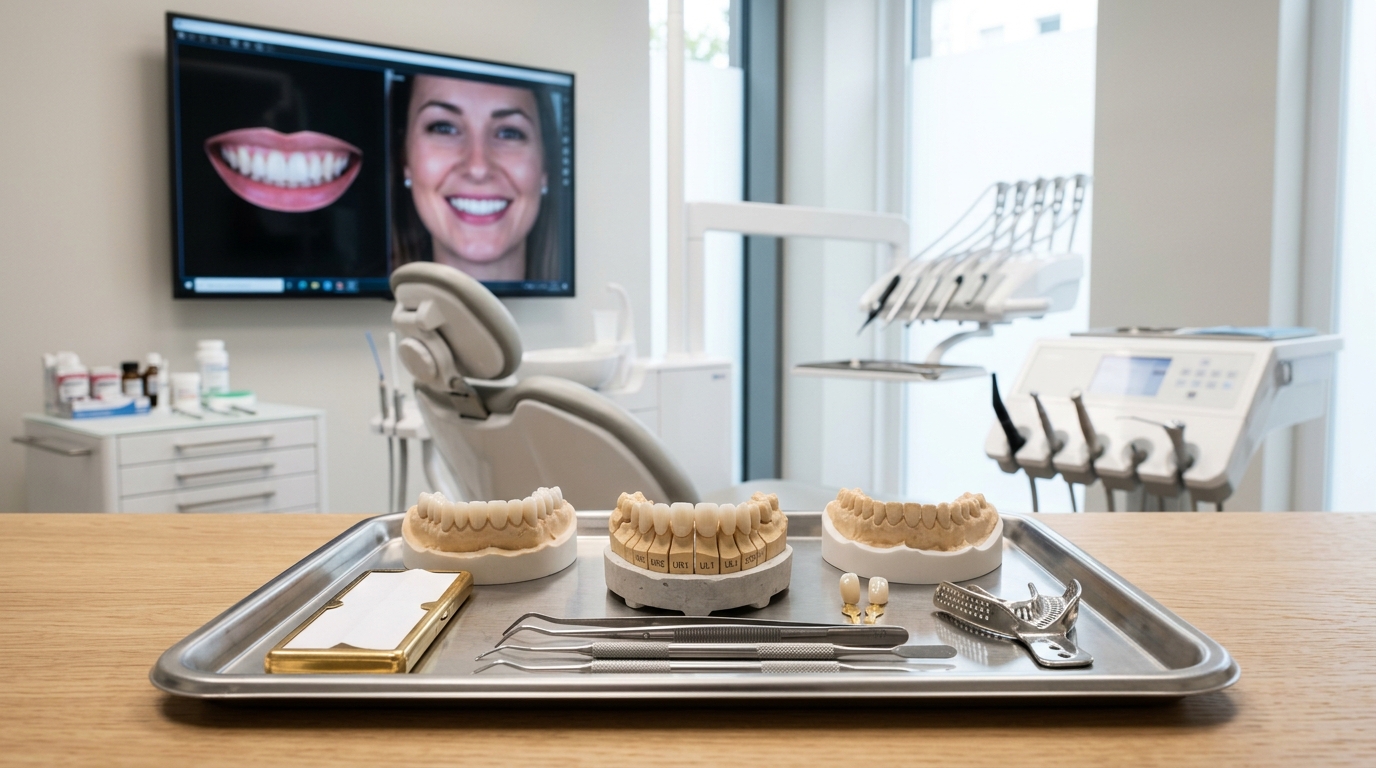
- Day 1 - Digital Smile Design (DSD) & Mock-up: High-definition facial photography and intraoral 3D scanning. The software creates a virtual simulation. A physical intraoral mock-up using bis-acryl resin is placed directly on your un-prepped teeth so you can visualize the aesthetic transformation in a mirror before any clinical intervention.
- Day 2 - Micro-Preparation & Digital Impressions: Under local anesthesia, the prosthodontist performs micro-reduction confined strictly to the outer enamel layer. An intraoral digital scan is transmitted directly to the master laboratory via CAD/CAM milling networks. High-grade temporary veneers are bonded to preserve function, speech, and thermal comfort.
- Days 3-4 - Laboratory Customization: Master dental ceramists mill the restorations using multi-axis CAD/CAM machines and hand-glaze the incisal edges to add natural lifelike depth, opalescence, and micro-texture.
- Day 5 - Clinical Try-In & Adhesive Bonding: The restorations are evaluated using water-soluble try-in pastes to verify shade, margin adaptation, contact tightness, and phonetics. Once approved by the patient and dentist, the teeth are isolated under a rubber dam, etched with phosphoric acid, silanated, and bonded with resin cement.
4. Clinical Longevity, Maintenance & Night Guard Protocol
Clinical longitudinal studies demonstrate a 94% to 98% survival rate for lithium disilicate veneers at 10 years when bonded to enamel. To maximize longevity and prevent marginal microleakage or fractures:
- Custom Night Guard: Patients with clenching or bruxism tendencies must wear a hard-acrylic occlusal night guard every night. Excessive shear forces are the leading cause of ceramic chipping.
- Non-Abrasive Dentifrice: Utilize non-abrasive fluoride toothpastes (RDA under 70). Highly abrasive charcoal or whitening pastes can scratch the protective glazed surface of the porcelain.
- Biannual Hygiene Maintenance: Professional cleaning using ultrasonic tips with plastic sleeves or air-polishing with glycine powder prevents micro-scratches along the margin line.
5. Cost Comparison: Europe, UK vs. Turkey (2026 Index)
In London, Manchester, Zurich, or Frankfurt, a complete 16 to 20-unit porcelain smile makeover costs between £14,000 and £24,000 (€16,500 to €28,000). In certified Turkish clinics accredited by the Ministry of Health (T.C. Sağlık Bakanlığı / USHAŞ), the identical procedure utilizing genuine Swiss Ivoclar e.max or German Vita materials costs between £3,200 and £5,600. This 70% price efficiency is driven by favorable operational overheads, currency dynamics, and lower laboratory fabrication fees, without compromising material authenticity or clinical rigor.
Clinical Frequently Asked Questions (FAQ)
Will my teeth be shaved down to small pegs or shark teeth?
No. Aggressive reduction into pegs is a hallmark of non-regulated clinics performing aggressive full-crown preparations. Modern aesthetic dentistry focuses on minimal-prep veneers, removing merely 0.3 to 0.5 mm of enamel on the facial aspect while leaving over 90% of your coronal tooth structure completely intact.
Which shade should I select: Bleach White or Natural?
Your prosthodontist will evaluate the sclera (white of your eyes) and facial skin undertones. Ultra-white bleach shades (BL1, BL2) provide a striking celebrity appearance, whereas shades like A1 or B1 offer natural brilliance with subtle cervical warmth and incisal translucency. You will evaluate the shade during your physical mock-up trial.
What happens if a veneer chips or debonds after I return home?
Debonding is rare when restorations are bonded to enamel using dual-cure resin cements. Accredited clinics archive your original CAD/CAM 3D STL files for life. If a fracture occurs, a replacement unit can be precision-milled instantly and dispatched to your local dentist or replaced under the clinic's formal written warranty.