
Optical Photogrammetry & Deep-Learning CAD Systems
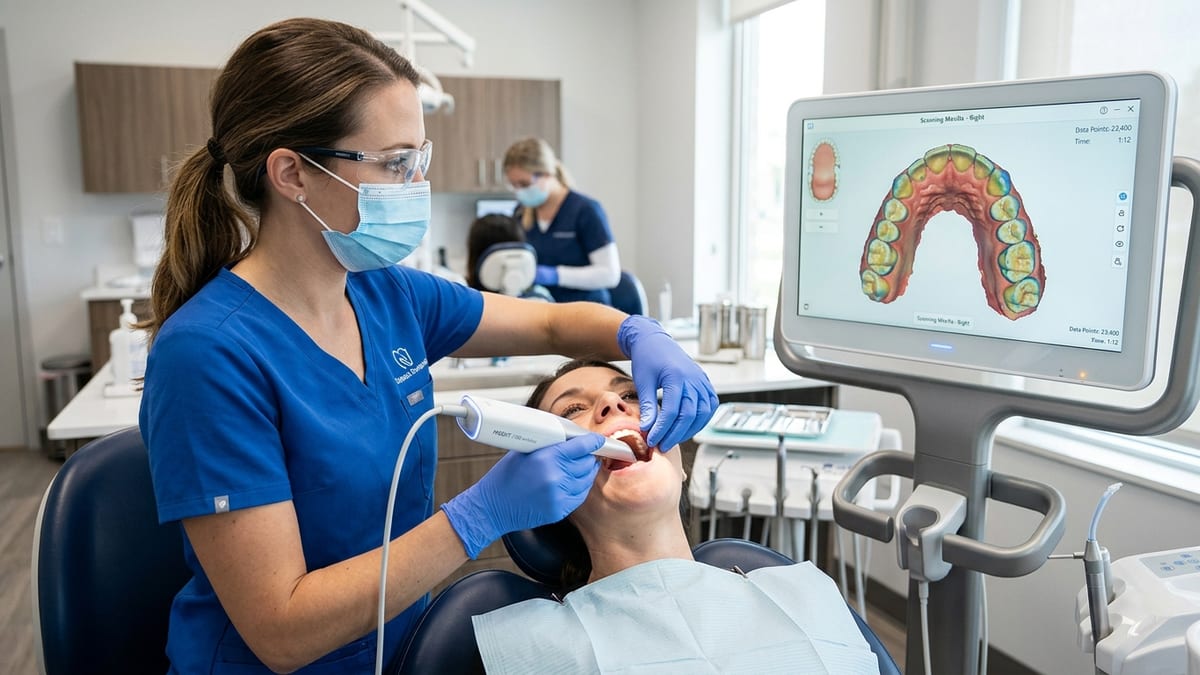
The integration of Artificial Intelligence (AI) and 3D intraoral scanning has eliminated physical elastomeric impression trays, transforming prosthodontic accuracy. Modern optical scanning wands (such as 3Shape TRIOS 5, Medit i700, and Dentsply Sirona Primescan) employ structured confocal light and neural network algorithms to render micron-level 3D dental meshes, detecting margin lines and subgingival emergence profiles with unprecedented speed and zero patient gag reflex.
1. The Technology: Confocal Microscopy & AI Artifact Filtering
Traditional dental impressions utilized alginate or polyvinyl siloxane (PVS) putty, known for inducing patient gagging and suffering volumetric distortion due to polymerization shrinkage and moisture contamination. Modern intraoral scanners utilize confocal microscopy or active wavefront sampling to project structured laser patterns onto oral tissues. Solid-state sensors capture thousands of optical frames per second, stitched together by neural network algorithms.
AI algorithms filter out extraneous soft tissues in real-time—instantly deleting the patient's tongue, fluttering buccal mucosa, or gloved fingers from the rendering field. The result is a clean, artifact-free 3D digital point cloud with an accuracy margin under 20 microns.
2. Clinical Precision: Marginal Fit & Secondary Caries Prevention
The single most important determinant of crown and veneer longevity is marginal fit. An ill-fitting crown margin creates a microscopic gap exceeding 120 microns, through which oral fluids and bacteria penetrate to cause secondary caries and cement wash-out. Studies show CAD/CAM restorations fabricated from high-end intraoral scans achieve marginal discrepancies of just 35 to 55 microns—far superior to traditional stone model casting techniques.
| Impression Metric | Traditional Alginate / Putty | AI 3D Intraoral Scanning |
|---|---|---|
| Patient Comfort | High gag reflex, unpleasant taste | 100% comfortable, wand glides smoothly |
| Acquisition Time | 15 to 20 min (mixing, setting, pouring) | 45 to 60 seconds per full arch |
| Marginal Discrepancy | 90 to 140 microns | 35 to 55 microns (Ultra-precise) |
| Volumetric Distortion | 0.5% - 1.5% material shrinkage | Zero physical shrinkage (Digital mesh) |
| Transfer Speed to Lab | 1 to 3 days courier transit | Instant cloud transmission in seconds |
3. AI Occlusal Dynamic Tracking & Caries Detection
Beyond capturing geometric shapes, next-generation 3D scanners incorporate advanced diagnostic capabilities:
- Digital Occlusion Mapping: Real-time color-coded bite analysis measures occlusal clearance and pressure distribution in microns, ensuring new crowns do not have high contact points that cause masticatory pain.
- Near-Infrared Transillumination (NIRI): Scanners like the iTero Element 5D utilize infrared light to illuminate the internal crystalline structure of teeth, identifying interproximal dental decay between teeth without exposing patients to ionizing radiation.
- AI Margin Line Detection: Machine learning models trained on millions of clinical preparations automatically delineate the preparation finish line, assisting master technicians in designing perfect crown seals.
4. Seamless CAD/CAM Integration & Same-Day Dentistry
Once the digital scan is finalized, the open STL/PLY mesh file is transmitted directly over cloud networks to 5-axis milling units. High-strength zirconia blocks or lithium disilicate blocks are milled within 15 minutes, allowing accredited Turkish clinics to deliver single crowns, onlays, and veneer prototypes on the same day.
Clinical Frequently Asked Questions (FAQ)
Can intraoral scanners scan teeth underneath the gumline?
Yes. By pairing the scanner with atraumatic gingival retraction cords or diode laser troughing, scanners capture subgingival preparation finish lines with extreme optical clarity.
Is 3D intraoral scanning safe for pregnant patients?
Yes, 100% safe. Intraoral scanners use harmless optical LED and visible laser light. They emit zero ionizing radiation, making them completely safe for pregnant and pediatric patients.
How does digital scanning benefit international dental tourists?
It cuts clinical turnaround time in half. Eliminating physical stone plaster pouring and courier transit allows clinics in Turkey to fabricate custom ceramic restorations in 48 to 72 hours, saving international patients valuable travel days.
Comprehensive Clinical Quality Assurance & Post-Operative Safety Protocols
Ensuring predictable, long-term biological stability for How AI and 3D Intraoral Scanning Are Revolutionizing Modern Dental Care: Precision, Speed & Comfort requires strict adherence to international evidence-based dental guidelines. Clinical success is not merely achieved during active treatment hours; it depends on the precise physiological management of surrounding hard and soft tissues during the critical post-operative healing window. When dental restorations or surgical implants are placed, the surrounding vascular architecture undergoes complex cellular remodeling, requiring patient-specific pharmacological support, occlusal load balancing, and anti-inflammatory hygiene protocols.
Every clinical case treated within accredited hospital-grade dental facilities in Turkey undergoes a multi-disciplinary quality review involving prosthodontists, periodontists, and oral surgeons. Prior to final discharge, high-resolution diagnostic intraoral scans and verification radiographs are captured to confirm marginal adaptation, absence of subgingival cement overhangs, and harmonic balance across dynamic excursive chewing movements. Patients receive an individualized clinical dossier containing high-resolution digital radiographs, complete manufacturer traceability lot numbers, and a 24/7 dedicated medical emergency line.
Contraindications, Clinical Risk Stratification & Biological Longevity
While modern digital dentistry delivers unprecedented clinical predictability, ethical clinicians must evaluate systemic and behavioral risk factors that could undermine biological longevity:
- Severe Nocturnal Bruxism & Parafunctional Clenching: Excessive unmanaged occlusal forces represent the leading mechanical cause of ceramic micro-fractures, screw loosening, and bone overload. Patients with verified bruxism must be fitted with custom-milled dual-laminate hard/soft occlusal night guards before departing for their home country.
- Compromised Periodontal Health: Active gingival inflammation or untreated periodontitis compromises the biological seal of crowns and implants. Complete scaling, root planing, and subgingival biofilm debridement must precede any definitive prosthodontic or surgical procedures.
- Systemic Microvascular Disorders: Heavy tobacco consumption and uncontrolled diabetes mellitus impair microvascular angiogenesis, delaying soft-tissue wound closure and increasing complication rates. Clinicians require strict smoking cessation during the perioperative phase.
By pairing world-class European biomaterials with rigorous biological safeguards, patients achieve functional comfort, pristine aesthetics, and clinically documented survival rates spanning decades.