
Orthodontic Biomechanics & Clear Aligner Science
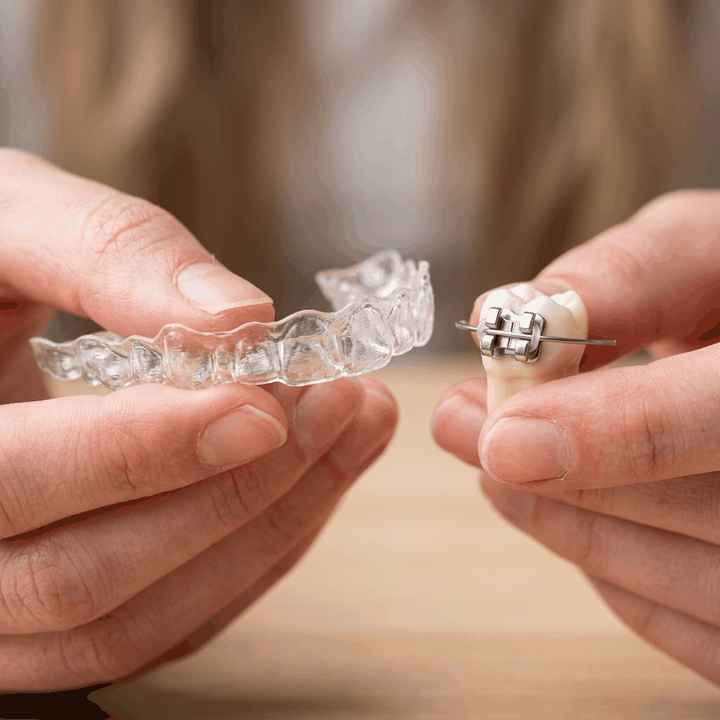
Contemporary orthodontics offers two primary modalities for correcting malocclusion: custom-molded thermoformed clear aligners (such as Invisalign and Spark) and fixed multi-bracket orthodontic appliances (traditional and self-ligating metal or ceramic braces). Comparing these systems requires evaluating cellular bone remodeling, torque control, patient compliance, and periodontal health during tooth movement.
1. Cellular Mechanics of Orthodontic Tooth Movement
Both aligners and traditional braces move teeth using identical biological physiology: the mechanical application of continuous light orthodontic force creates areas of compression and tension within the periodontal ligament (PDL). On the pressure side, osteoclasts resorb alveolar bone; on the tension side, osteoblasts deposit newly mineralized osteoid. The fundamental difference lies in force delivery: fixed brackets deliver continuous multi-axial vectors, while clear aligners deliver intermittent, digitally staged displacement increments (typically 0.2 to 0.25 mm per tray).
2. Biomechanical Comparison: Bodily Translation vs. Tipping Forces
Evaluating clinical indications is crucial for successful orthodontic outcomes:
- Clear Aligners (Polyurethane Multilayer Polymers): Excel in dental arch expansion, incisor intrusion/proclination, and resolving mild to moderate crowding. SmartForce attachments (tooth-colored composite buttons bonded to enamel) provide engagement surfaces that allow aligners to execute complex root uprighting and rotational movements.
- Fixed Brackets (Metal / Ceramic / Lingual): Maintain clinical superiority in complex severe malocclusions involving severe skeletal discrepancies, impacted canine exposure, heavy premolar extraction space closures, and severe vertical extrusion movements. Fixed appliances operate 24/7 without requiring patient compliance.
| Clinical Factor | Clear Aligners (Invisalign / Spark) | Traditional Fixed Braces |
|---|---|---|
| Aesthetic Visibility | Virtually invisible transparent plastic | Visible metal or ceramic brackets / wires |
| Oral Hygiene & Flossing | Removable; normal flossing & brushing | Complex; requires floss threaders & wax |
| Enamel Decalcification (White Spots) | Extremely rare (<1%) | Documented in 20% - 30% of poor brushers |
| Compliance Requirement | Strict (20 to 22 hours per day) | Zero compliance (Fixed permanently) |
| Dietary Restrictions | None (Removed while eating) | Avoid hard, sticky, or crunchy foods |
3. Digital Planning: ClinCheck 3D Simulation & Treatment Staging
Modern aligner therapy relies on digital predictability. Utilizing high-resolution intraoral scans, orthodontists plan every millimetric movement using CAD orthodontic software (e.g., Align ClinCheck). The software maps out the exact number of aligners, velocity of movement, and precise location of attachments. Patients can view a virtual 3D time-lapse simulation of their teeth shifting into final occlusion before manufacturing begins.
4. Cost Comparison: UK/Europe vs. Turkey Orthodontic Packages (2026)
Comprehensive Invisalign comprehensive treatment in London or Dublin costs £3,500 to £6,000 (€4,000 to €7,000). In accredited Turkish orthodontic centers, full dual-arch clear aligner treatment utilizing genuine Invisalign or Spark systems costs between £1,600 and £2,600 (€1,850 to €3,000). Patients complete their 3D scan and attachment bonding in Turkey, receiving their full sequence of numbered aligners to take home with remote tele-orthodontic monitoring via AI dental apps.
Clinical Frequently Asked Questions (FAQ)
How many hours per day must I wear my clear aligners?
You must wear your aligners for at least 20 to 22 hours every single day, removing them only for meals, hot beverages, and brushing. Failing to achieve 20 daily hours stalls cellular bone remodeling, causing teeth to stop tracking within the aligner trays.
Will clear aligners give me a temporary speech lisp?
Most patients experience a slight minor lisp on 'S' and 'Th' sounds for the first 48 to 72 hours. As the tongue rapidly adapts to the 0.75 mm polymer thickness over the incisors, speech returns to complete normal fluency.
Do I need retainers after completing aligners or braces?
Yes, retention is lifelong regardless of which orthodontic system you choose. To prevent mesial drift and physiological relapse, orthodontists place a bonded lingual wire behind the front six teeth combined with clear night retainers (Vivera retainers) worn during sleep.
Comprehensive Clinical Quality Assurance & Post-Operative Safety Protocols
Ensuring predictable, long-term biological stability for Clear Aligners vs. Traditional Braces: Clinical Indications, Treatment Speed, Comfort & Cost Comparison requires strict adherence to international evidence-based dental guidelines. Clinical success is not merely achieved during active treatment hours; it depends on the precise physiological management of surrounding hard and soft tissues during the critical post-operative healing window. When dental restorations or surgical implants are placed, the surrounding vascular architecture undergoes complex cellular remodeling, requiring patient-specific pharmacological support, occlusal load balancing, and anti-inflammatory hygiene protocols.
Every clinical case treated within accredited hospital-grade dental facilities in Turkey undergoes a multi-disciplinary quality review involving prosthodontists, periodontists, and oral surgeons. Prior to final discharge, high-resolution diagnostic intraoral scans and verification radiographs are captured to confirm marginal adaptation, absence of subgingival cement overhangs, and harmonic balance across dynamic excursive chewing movements. Patients receive an individualized clinical dossier containing high-resolution digital radiographs, complete manufacturer traceability lot numbers, and a 24/7 dedicated medical emergency line.
Contraindications, Clinical Risk Stratification & Biological Longevity
While modern digital dentistry delivers unprecedented clinical predictability, ethical clinicians must evaluate systemic and behavioral risk factors that could undermine biological longevity:
- Severe Nocturnal Bruxism & Parafunctional Clenching: Excessive unmanaged occlusal forces represent the leading mechanical cause of ceramic micro-fractures, screw loosening, and bone overload. Patients with verified bruxism must be fitted with custom-milled dual-laminate hard/soft occlusal night guards before departing for their home country.
- Compromised Periodontal Health: Active gingival inflammation or untreated periodontitis compromises the biological seal of crowns and implants. Complete scaling, root planing, and subgingival biofilm debridement must precede any definitive prosthodontic or surgical procedures.
- Systemic Microvascular Disorders: Heavy tobacco consumption and uncontrolled diabetes mellitus impair microvascular angiogenesis, delaying soft-tissue wound closure and increasing complication rates. Clinicians require strict smoking cessation during the perioperative phase.
By pairing world-class European biomaterials with rigorous biological safeguards, patients achieve functional comfort, pristine aesthetics, and clinically documented survival rates spanning decades.