
Biomaterial Comparison & Long-Term Aesthetic Survival
Selecting between composite resin veneers and custom porcelain laminate veneers represents a fundamental clinical choice in aesthetic rehabilitation. While composite bonding offers a rapid, conservative, lower-cost immediate solution, porcelain veneers (lithium disilicate / E.max) provide superior optical mimicry, stain immunity, and a clinically proven 15 to 20-year survival rate that far outlasts polymer resin restorations.
1. Material Composition & Structural Degradation
The core differences between composite and porcelain arise from their fundamental chemical compositions:
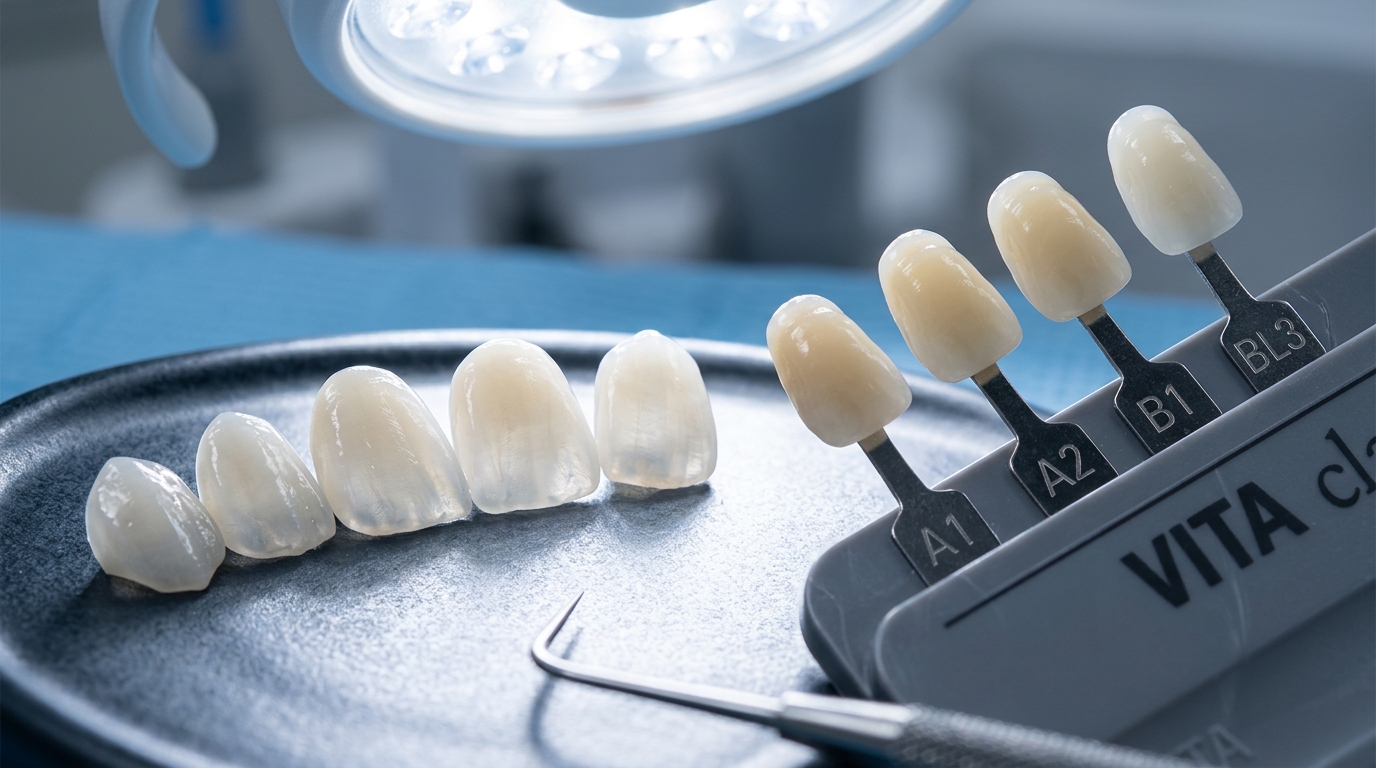
- Porcelain Laminate Veneers (Ceramic): Sintered glass-ceramics (IPS e.max lithium disilicate or feldspathic porcelain) are completely inorganic and vitreous. Having zero porosity, ceramic surfaces cannot absorb fluid, dietary pigments, or bacteria. They maintain their factory gloss indefinitely without periodic polishing.
- Composite Resin Veneers (Polymer): Composed of organic dimethacrylate resins (Bis-GMA, UDMA, TEGDMA) filled with inorganic silica nanoparticles. Over 3 to 5 years, oral saliva and dietary acids induce micro-hydrolysis of the polymer matrix, leading to surface roughness, loss of luster, and marginal discoloration along the gumline.
2. Esthetics, Light Refraction & Enamel Mimicry
Natural tooth enamel possesses unique optical phenomena: opalescence (appearing amber in transmitted light and bluish in reflected light) and natural fluorescence under UV light. High-end ceramics faithfully replicate these properties due to their crystal matrix. Composite resins, while remarkably improved, absorb light differently and can appear comparatively monochromatic or dull under varied lighting conditions over time.
| Clinical Parameter | Porcelain Veneers (IPS e.max) | Composite Resin Veneers |
|---|---|---|
| Material Type | Inorganic Glass-Ceramic (Lithium Disilicate) | Organic Polymer Matrix + Silica Fillers |
| Flexural Strength | 470 - 530 MPa | 120 - 160 MPa |
| Stain Resistance | 100% Impervious to dietary stains | Susceptible to coffee, wine, nicotine stains |
| Surface Polish Retention | Permanent glazed luster | Requires annual chairside polishing |
| 10-Year Clinical Survival Rate | 94% - 98% | 55% - 70% |
| Average Lifespan | 15 to 20+ Years | 5 to 7 Years |
3. Biological Impact on Marginal Gingival Health
Biocompatibility with gingival tissue is critical for aesthetic outcomes. High-gloss glazed ceramics are the most tissue-friendly material in dentistry; bacterial plaque struggles to adhere to polished porcelain surfaces, resulting in healthy, pink, non-inflamed gingival margins. Conversely, composite resin margins are more prone to plaque retention and micro-roughness, requiring exceptional patient flossing habits to prevent marginal gingivitis.
4. Cost vs. Longevity: The True 10-Year Economic Picture
While composite veneers carry a lower initial price tag, they frequently require periodic maintenance, re-polishing, chipping repairs, and eventual full replacement every 5 to 7 years. Over a 15-year period, the cumulative cost of maintaining composite veneers often matches or exceeds the initial investment in long-lasting porcelain veneers.
Clinical Frequently Asked Questions (FAQ)
Can I switch from composite veneers to porcelain veneers in the future?
Yes. Because direct composite bonding rarely removes natural tooth enamel, the resin can be buffed away, and your teeth can be precision-prepared for permanent porcelain veneers at any point in the future.
Can porcelain veneers chip or break?
While porcelain veneers are exceptionally strong under compressive chewing forces, they can chip if subjected to extreme shear or tensile forces (such as biting into hard candy, opening bottles, or chronic night grinding). Wearing an occlusal night guard completely mitigates this risk.
Why do many international patients choose porcelain in Turkey?
In the UK or Europe, porcelain veneers cost £800 to £1,200 per tooth, making a full smile makeover cost prohibitive. In accredited Turkish clinics, genuine Swiss Ivoclar e.max porcelain veneers cost £200 to £280 per tooth, allowing patients to choose durable porcelain over temporary composite for a similar or lower total outlay.
Comprehensive Clinical Quality Assurance & Post-Operative Safety Protocols
Ensuring predictable, long-term biological stability for Composite Veneers vs. Porcelain Veneers: Clinical Longevity, Staining Resistance & Cost Comparison requires strict adherence to international evidence-based dental guidelines. Clinical success is not merely achieved during active treatment hours; it depends on the precise physiological management of surrounding hard and soft tissues during the critical post-operative healing window. When dental restorations or surgical implants are placed, the surrounding vascular architecture undergoes complex cellular remodeling, requiring patient-specific pharmacological support, occlusal load balancing, and anti-inflammatory hygiene protocols.
Every clinical case treated within accredited hospital-grade dental facilities in Turkey undergoes a multi-disciplinary quality review involving prosthodontists, periodontists, and oral surgeons. Prior to final discharge, high-resolution diagnostic intraoral scans and verification radiographs are captured to confirm marginal adaptation, absence of subgingival cement overhangs, and harmonic balance across dynamic excursive chewing movements. Patients receive an individualized clinical dossier containing high-resolution digital radiographs, complete manufacturer traceability lot numbers, and a 24/7 dedicated medical emergency line.
Contraindications, Clinical Risk Stratification & Biological Longevity
While modern digital dentistry delivers unprecedented clinical predictability, ethical clinicians must evaluate systemic and behavioral risk factors that could undermine biological longevity:
- Severe Nocturnal Bruxism & Parafunctional Clenching: Excessive unmanaged occlusal forces represent the leading mechanical cause of ceramic micro-fractures, screw loosening, and bone overload. Patients with verified bruxism must be fitted with custom-milled dual-laminate hard/soft occlusal night guards before departing for their home country.
- Compromised Periodontal Health: Active gingival inflammation or untreated periodontitis compromises the biological seal of crowns and implants. Complete scaling, root planing, and subgingival biofilm debridement must precede any definitive prosthodontic or surgical procedures.
- Systemic Microvascular Disorders: Heavy tobacco consumption and uncontrolled diabetes mellitus impair microvascular angiogenesis, delaying soft-tissue wound closure and increasing complication rates. Clinicians require strict smoking cessation during the perioperative phase.
By pairing world-class European biomaterials with rigorous biological safeguards, patients achieve functional comfort, pristine aesthetics, and clinically documented survival rates spanning decades.