
Facial-Driven Aesthetics & Intraoral Mock-Up Protocols
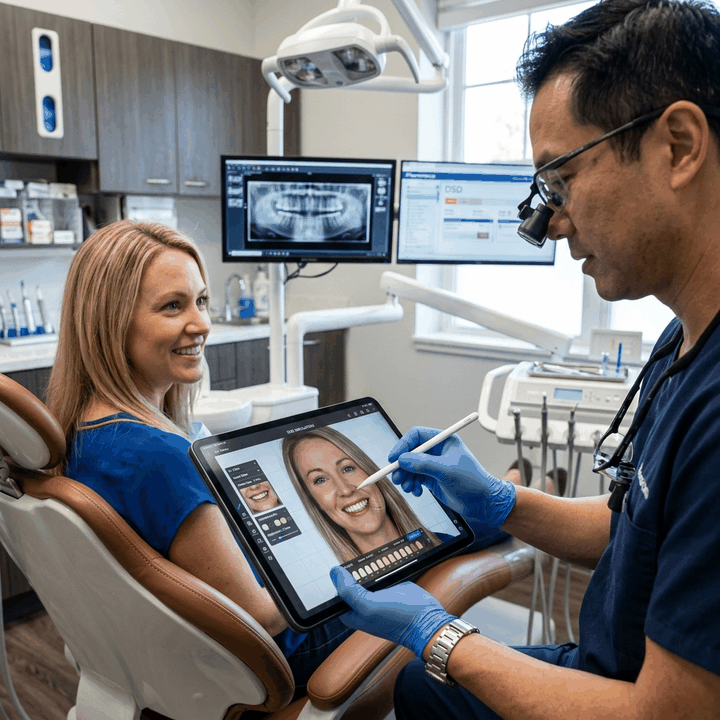
Digital Smile Design (DSD) is an advanced diagnostic aesthetic protocol created by Dr. Christian Coachman that establishes a harmonious relationship between facial morphology and dental architecture. By combining facial videography, 3D intraoral optical scans, and physical 3D mock-ups, DSD allows patients to visually co-design and physically test-drive their future smile in their own mouth before any irreversible tooth preparation takes place.
1. The Philosophy of Facial-Driven Smile Architecture
Historically, cosmetic dentistry operated isolated from the face; dentists took alginate impressions and sent stone models to laboratories without facial reference data. Digital Smile Design transformed this paradigm by establishing that tooth design must be dictated by facial balance, emotional expression, and dynamic lip kinetics:
- Interpupillary Horizontal Axis: The horizontal baseline of the smile must parallel the bipupillary line connecting the eyes.
- Facial Midline Alignment: The dental contact between the central incisors is calibrated relative to the facial midline (philtrum of the upper lip and glabella).
- Lip Line Dynamics & Incisal Curvature: During a natural spontaneous smile, the incisal edges of the upper teeth should follow the gentle upward curvature of the lower lip, displaying 1.0 to 2.0 mm of healthy interdental gingival papillae.
2. The Diagnostic Protocol: Videography, 3D Scans & Photogrammetry
Accredited clinics adhere to a rigorous 4-step digital data capture sequence:
- Dynamic 4K Video Recording: Capturing the patient speaking, laughing, and articulating specific phonetics ('E', 'F', 'V', 'M' sounds). Video reveals true dynamic lip dynamics that static 2D photographs miss entirely.
- Intraoral Optical 3D Mesh (STL/PLY): Scanners capture the exact gingival architecture, tooth contours, and occlusal clearance with sub-millimeter precision.
- 3D Software Calibration (CAD Smile Design): The 2D facial video frames and 3D dental scans are fused within CAD software. The prosthodontist shapes virtual tooth proposals using Golden Proportion ratios and biometric tooth libraries.
- 3D Printing the Physical Diagnostic Wax-up: The virtual design is converted into a physical resin model using high-precision DLP/SLA 3D printers.
| Diagnostic Phase | Traditional Cosmetic Dentistry | Digital Smile Design (DSD) Protocol |
|---|---|---|
| Diagnostic Workup | Static stone models and hand wax-ups | Dynamic 4K videography + 3D facial integration |
| Patient Preview | None; patient sees teeth only upon cementation | Intraoral physical mock-up trial in mouth |
| Enamel Reduction Precision | Free-hand bur reduction (Risk of overtreatment) | Guided micro-prep through silicone index |
| Laboratory Error Risk | Subjective interpretation by ceramist | 100% digital STL transfer to 5-axis CAD/CAM |
3. The Intraoral Mock-Up: Test-Driving Your New Smile
The mock-up is the defining pinnacle of DSD. A silicone index generated from the 3D-printed model is filled with temporary bis-acryl aesthetic resin and seated directly over your natural teeth without any anesthesia or drilling. In less than 3 minutes, the resin hardens into a tangible, high-definition preview of your future smile. You look in a mirror, speak, smile, and record a reaction video, experiencing your new teeth in real-time before agreeing to any permanent treatment.
4. Precision Guided Tooth Preparation
Because the final tooth shapes are locked into the 3D design, the dentist preps through the mock-up using a silicone preparation guide. This guarantees that tooth reduction occurs only where mathematically necessary, preserving maximum enamel for superior long-term adhesive bonding.
Clinical Frequently Asked Questions (FAQ)
Can I request changes to my teeth after seeing the mock-up?
Yes. That is the entire clinical objective of DSD. If you want teeth slightly rounder, longer, softer, or wider, the dentist modifies the resin chairside instantly until you approve the design.
Does Digital Smile Design cost extra in Turkey?
In accredited cosmetic centers in Turkey, comprehensive DSD diagnostic videography, 3D facial planning, and physical mock-up sessions are integrated complimentary within your comprehensive veneer or smile makeover package.
How long does the DSD mock-up session take?
The entire diagnostic appointment—including high-definition photo/video capture, 3D scanning, digital calibration, and mock-up trial in the chair—takes approximately 60 to 90 minutes.
Clinical Governance, Legal Safeguards & Cross-Border Regulatory Compliance
Scaling operational capacity for Digital Smile Design (DSD): How 3D Virtual Simulations Preview Your Smile Before Treatment Begins requires strict adherence to international medical deontology and statutory regulations. Cross-border healthcare operates within a complex cross-jurisdictional framework where clinical communication, patient informed consent, and digital health data security must be maintained at the highest institutional standards. Developing resilient operational safeguards protects clinics against professional indemnity disputes, preserves reputation equity, and elevates international patient lifetime value.
Clinical governance committees within premier dental centers must establish continuous clinical peer-review processes. Every patient case record—encompassing 3D CBCT DICOM files, dynamic intraoral scans, pre-operative medical clearance reports, and post-operative occlusion photographs—must be archived in secure cloud-based electronic health record (EHR) platforms compliant with GDPR, KVKK, and international healthcare data privacy standards. Standardizing written multi-language consent forms guarantees that patients fully comprehend biological healing timelines, material choices, and contingency revision policies before boarding flights.
Key Performance Indicators (KPIs) & Sustainable Practice ROI
To evaluate the long-term clinical and economic success of these specialized protocols, practice administrators must track four mission-critical operational benchmarks:
- First-Time Fit & Remake Rate: Keeping CAD/CAM prosthodontic remakes strictly below 2% through digital intraoral photogrammetry and high-precision milling calibration.
- Inquiry-to-Treatment Velocity: Reducing the average friction window between initial patient diagnostic submission and confirmed travel booking from 18 days to under 6 days.
- Net Promoter Score (NPS) & Review Sentiment: Maintaining a verified patient NPS score above +85, driven by proactive post-operative follow-up and seamless bilingual coordinator support.
- Blended Customer Acquisition Cost (CAC) Efficiency: Shifting away from volatile pay-per-click bidding wars toward performance-aligned, zero-CAC platform partnerships (such as ask.dentist) that preserve surgical operating margins.
Integrating these clinical governance pillars enables surgical dental centers to achieve predictable clinical outcomes, maximize surgical theater productivity, and build globally respected medical brands.